
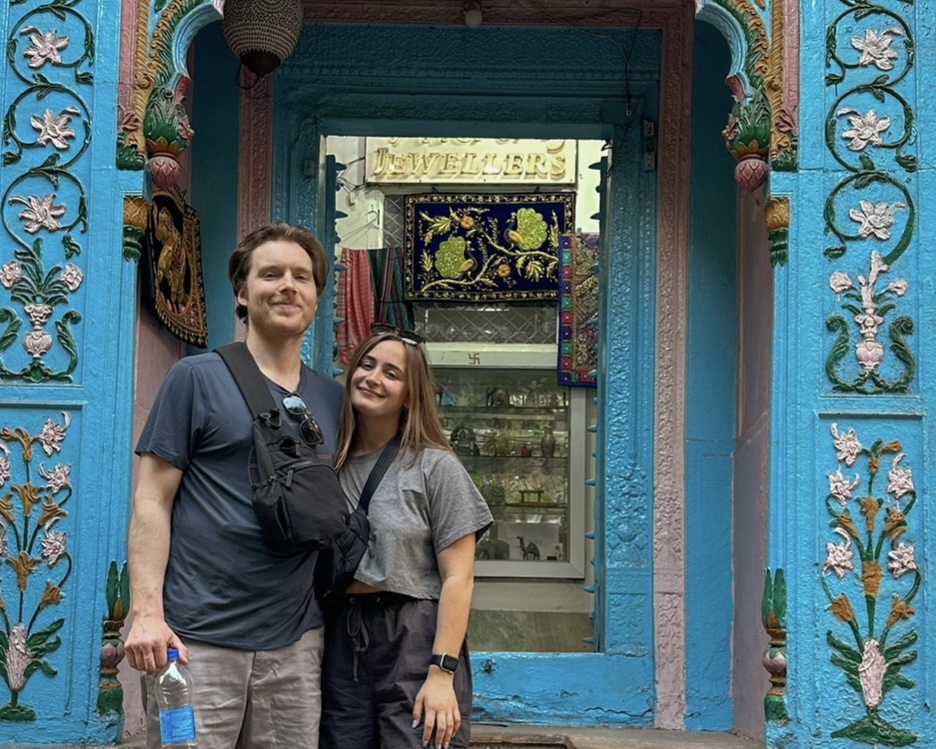
Wanderlusted too hard and woke up in India
“Hello, New York!” I woke up and instantly chose violence: why not channel my inner Hannah Montana: The Movie? I envisioned myself as her, bounding down the steps of my private jet and flinging my arms out wide to greet the hundreds of fans that I knew would be waiting for me upon landing. Except in this version, I was flinging open the window of my hostel (i.e., cranking a lever and aggressively shoving up the glass panel after several unsuccessful tries) and greeting three pigeons and two Indian men doing laundry in the alleyway. “Hello, India,” I whispered, peering nervously down into the alley and trying to avoid the intense stares of the pigeons. It hit me in that moment where we were: how far we were from home, how different the culture was, how new and unfamiliar everything we saw in the next few days was going to be. A thrill ran through me. That alley was my first view of India in the light of day, and I was eager to get out and explore more.
When we arrived the night before, everything was cloaked in darkness, and our exposure was both limited and brief. We weren’t alert, either: exhaustion shrouded our observational skills. I knew the light of day would illuminate everything, and I was fidgeting with eagerness to see this new country, on this new continent. Our hostel was peaceful, almost quiet–a self-described oasis in the chaos–and I had a sneaking suspicion that the tranquility would not carry over anywhere else.
The medium-risk, high-reward journey towards food
As we stepped out the front doors, it felt like we stepped into another world: into India, for the first time. Hotels were adorned with neon signs running in vertical lines: one lit-up block per letter of the name. And things were green: leafy ferns were propped up along the sidewalk, and pothos vines crawled down from baskets above our heads (well, above my head, but I’m painfully short, so most everything is above my head). I wasn’t expecting so much green in a city, but I barely had time to process that because I was so taken aback by all the sounds. That was the most glaring of all: how loud it was. There were people everywhere we looked, talking and laughing and arguing and working and driving. Cars and bikes and rickshaws sped by, the honking of horns never ceasing. I was disoriented by how much there was to take in, but there was no time to waste: freezing expresses uncertainty, and uncertainty invites company. Besides, we had a tour to get to!
Our booking was called “The Great Indian Food Tour: Old Delhi Food and Heritage Walk,” found here. We scheduled it on Tripadvisor weeks in advance, intentionally slotting it in as our first big excursion. Our hope was that it would run like an introductory course to Indian cuisine, providing us tips for avoiding illness, recommendations for popular spots to eat, and a broader sense of what the culture is like. Food is culture, and it’s my favorite way to immerse myself in new places. This tour in particular was perfect for our purposes, and the meeting point–Connaught Place, an area we wanted to explore anyway–wasn’t more than a twenty-minute walk from our hostel. So we set off, false bravado plastered on.
And then began the stares. Everyone was staring at us. I’m too anxious to be stared at by everyone! If two people stare at me–and, god forbid, laugh–back at home, I’m instantly ready to curl up and die, regardless of the circumstances for why they’re staring and laughing. Most of the time it probably has nothing to do with me, but that doesn’t matter. It feels personal. So having dozens of people turning their heads to look at us, unabashedly scanning us from head to toe, knowing for a fact it was personal… unnerving doesn’t cut it.
Then people started following us. “Hello, you’re going the wrong way,” a man said, sidling up beside us as if we were old friends linking up for a walk. Off we went, us three, two of us questioning how we could possibly be going the wrong way already. I let Mitch take the lead on this one, thanking the man in a polite dismissal. Soon after, another man took his place, greeting us and asking where we’re from. This happened a couple times on our twenty-minute walk, and the people we talked to were so damn nice that my desire to be friendly and respectful felt at odds with my desire to stay safe. How do we discern the people who are just trying to get to know us and make us feel welcome from the people that are eyeing up our wallets? In Philly, if I was approached by a stranger, I would probably not be polite. In Europe, it varies by place. I realized with dismay that I didn’t know the etiquette here, so we resorted to being brusque, responding curtly or turning people away with a quick “thank you, have a nice day” if they persisted.
The funny thing was that as soon as we met up with our tour guide, the approaches from strangers immediately stopped. I barely took notice, though, because I was so entranced with our guide, Sonali. She gave me good vibes instantly. In a white tee and jeans, hair pulled back and face bare–showing off a natural beauty that never asks for makeup–she seemed casually cool, almost liberal in comparison to some of the other states of dress we’d already seen. She took us down into an impressively clean and well-run metro station, and advised us to use the bathroom there because they wouldn’t be available for the rest of the tour. I felt immediate pee-panic. Now, I have worked more seven to eight hour shifts without once using the bathroom than I can count. I am a no-stops roadtripper. Yet as soon as I hear “no bathrooms available for a couple hours,” I can feel my bladder turn on and start running like an old machine whirring to life. I tried to pee out all my panic pee then, reassuring myself of our private bathroom in the hostel. I also thought fondly of my past self–the girl who researched carefully and thoroughly for this–as I reached into my fanny pack and pulled out a small roll of toilet paper. Thank you, past self. If I can pass along any wisdom to someone looking to travel to Asia, it would be to carry hand sanitizer and toilet paper with you wherever you go, because there’s slim odds that you’ll encounter either of these things in public restrooms, and for me, both are essential.
That said, we hopped on the metro train car, and headed off to Chandni Chowk. The next four hours were a beautiful, glorious blur of delicious food.
The high-reward in question
Here is everything we tried:
1. Mango Kulfi
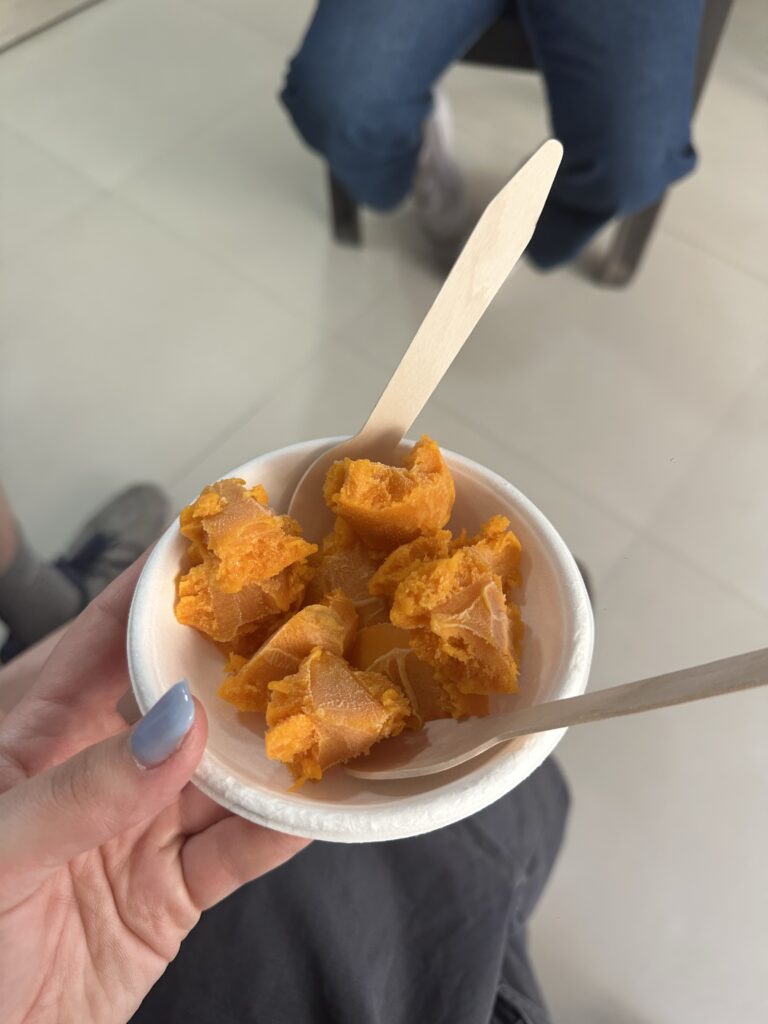
Kulfi is a traditional Indian ice cream made from milk, sugar, flavorings like cardamom or saffron, chopped nuts, and fruit purees–mango in this case. It was so good! I’d love to try making it on my own at home.
2. Aloo Chaat
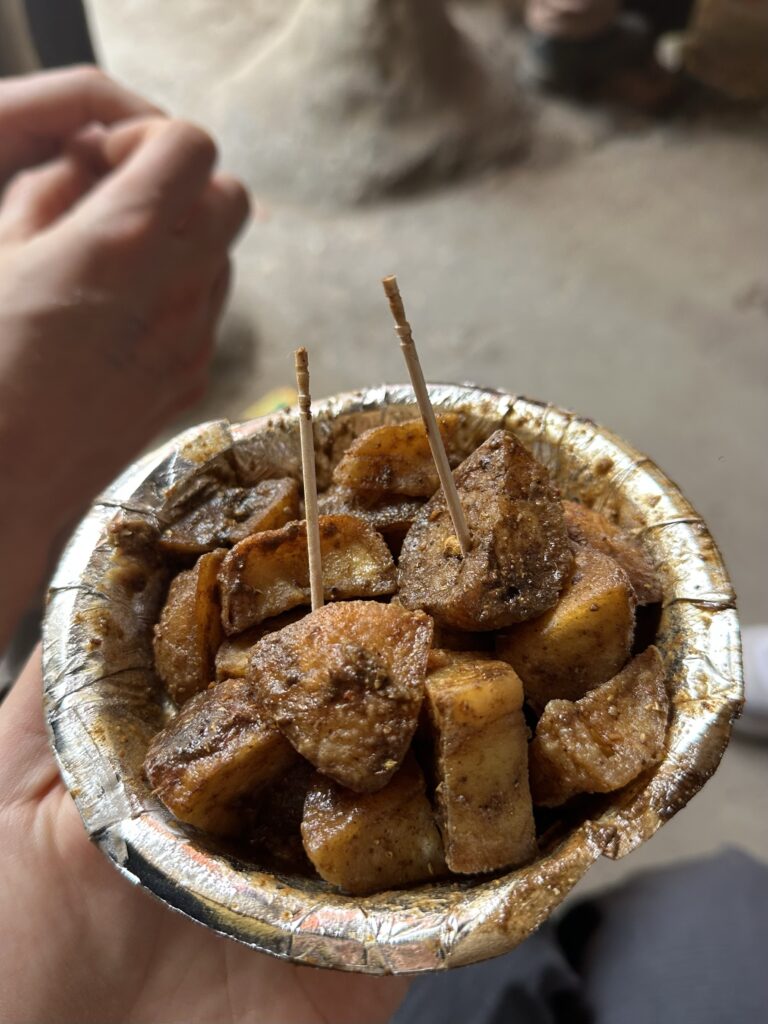
Chaat is a super popular street food that can be made with lots of variations. Aloo chaat is made with potatoes (they’re fried in ghee, a clarified butter used for cooking in many Indian dishes) and mixed with cumin, salt, chaat powder and amchoor, which is dried and powdered mango skin. It. Was. Gas. I could eat this every day!
3. Pineapple Chaat
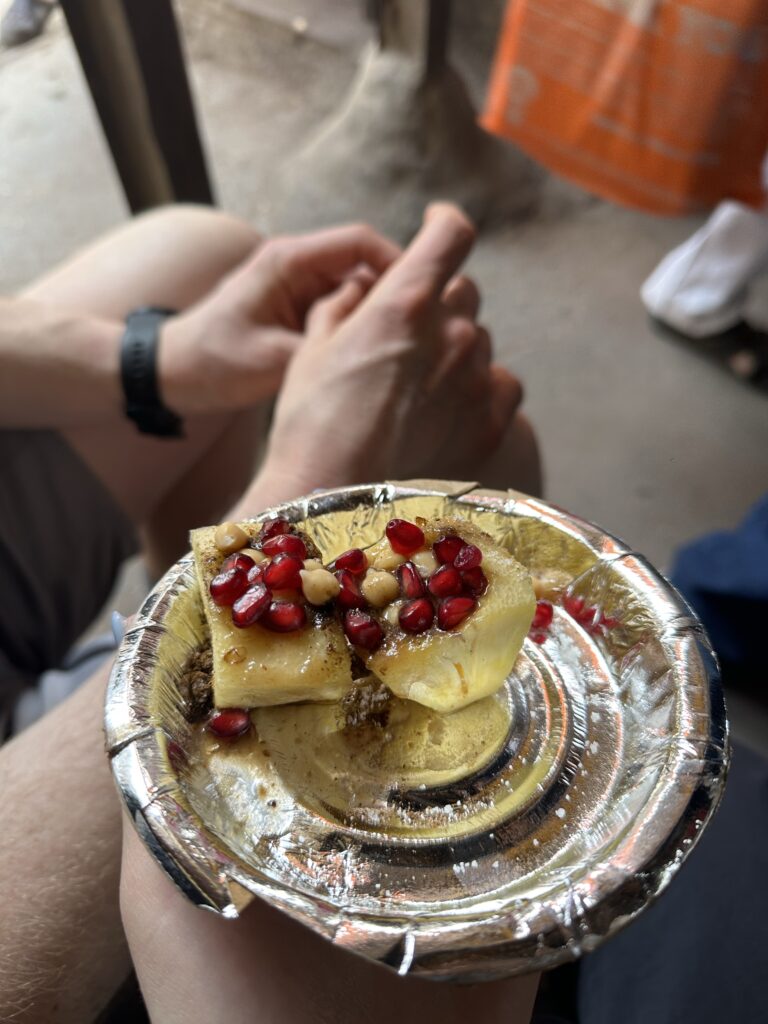
A more dessert-like chaat: pineapples stuffed with chickpeas, pomegranate seeds, and the same spices in the aloo chaat. Both types of chaat were probably my favorite things on the food tour! The pineapple chaat was such an amazing mix of sweet and spicy.
4. Vegetable Samosas
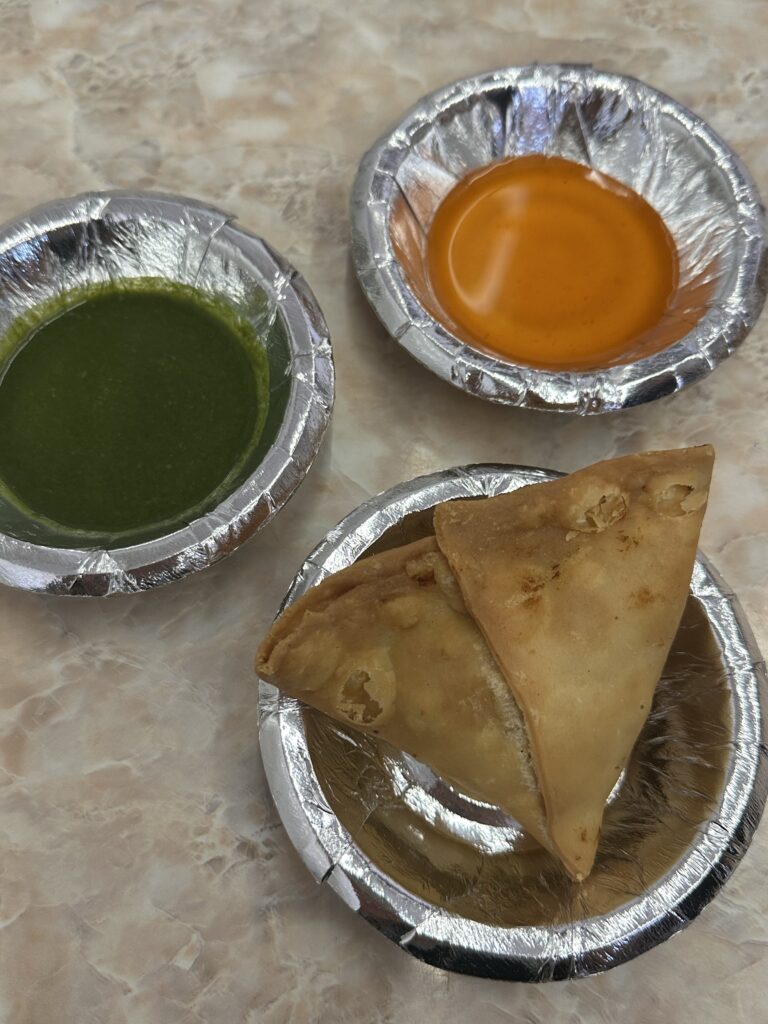
Pretty self-explanatory but so fire! Made out of wheat flour and fried in ghee, stuffed with boiled potatoes, peas, and raw spices. I really wanted to order more of these but refrained since we had a lot of food left to try!
5. Chai
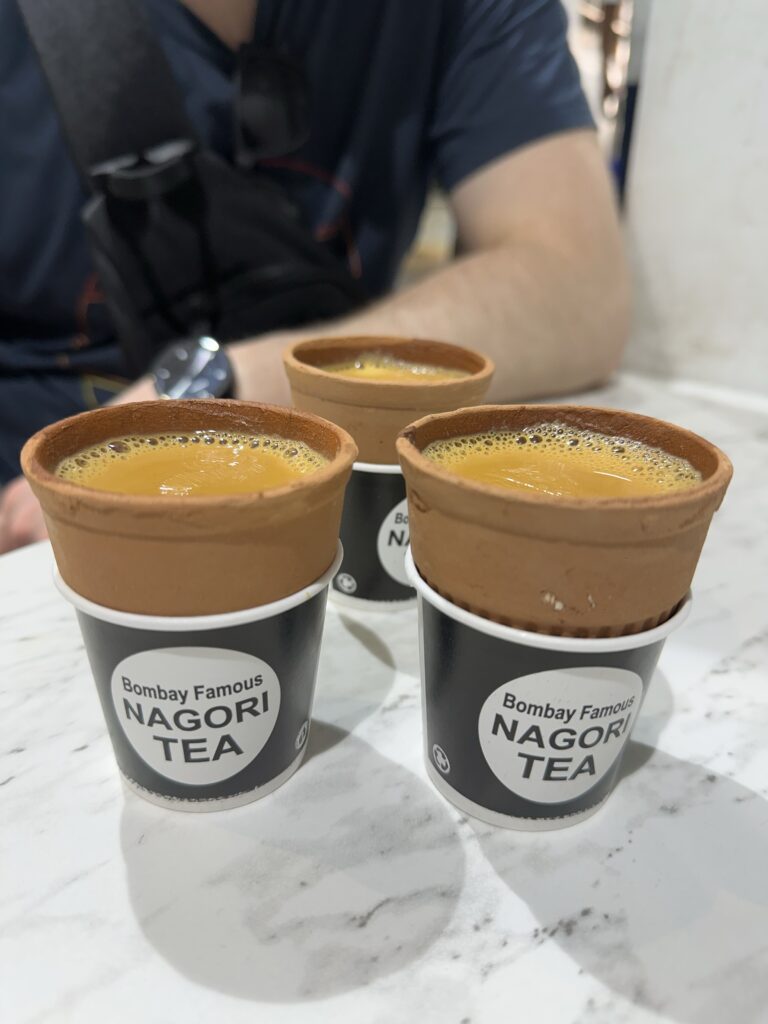
I was a little hesitant to drink anything other than bottled water because we were really trying to make it out unscathed (foreshadowing) but hot drinks that have been boiled are typically safe for tourists and I trusted our guide! This chai was really good, but it tastes very different from what we have at home. American chai is sweetened and made with less spices, but Indian chai typically uses a complex blend of spices like ginger, cardamom, cloves, black pepper, and cinnamon.
6. Kaju Katli
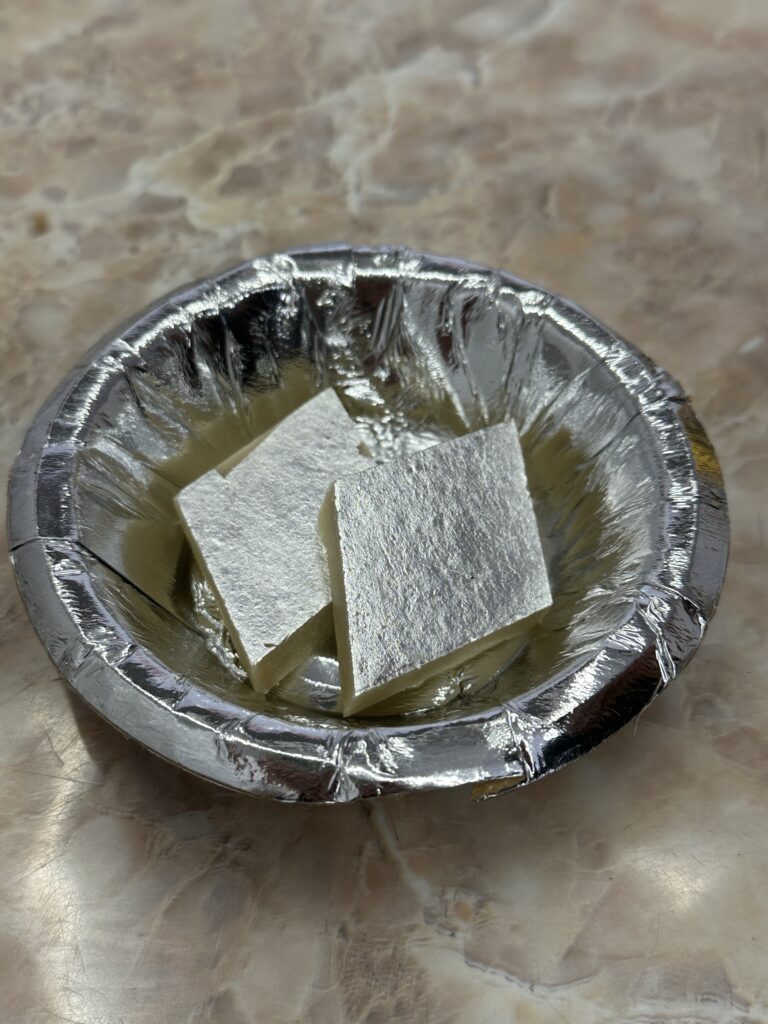
A dessert made with cashews and sugar, topped with vark (also varak waraq or warq), which is a foil sheet commonly used to decorate Indian sweets. Honestly, I didn’t love it. It was a tough texture to chew and not that great of a flavor in my opinion.
7. Lassi
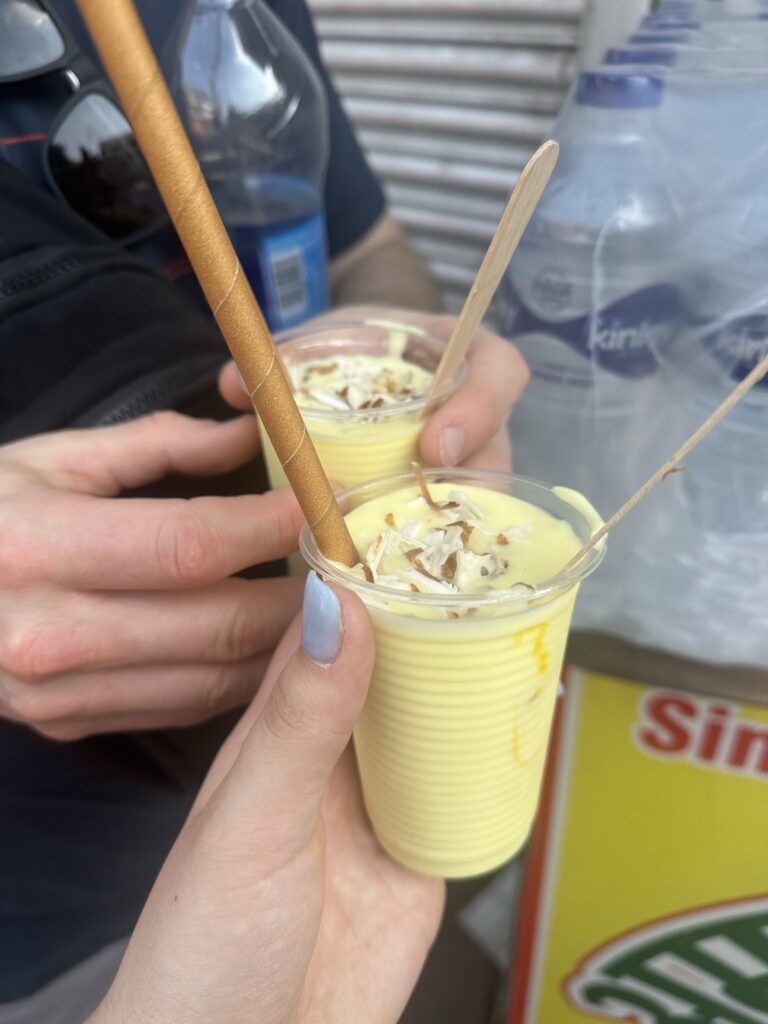
Lassi is a yogurt-based beverage blended with water and spices so that it has the consistency of a smoothie. Sonali told us that in Punjab, it’s made from water buffalo milk to which I was just like okay period because I had never heard of water buffalo milk before.
8. Bedmi Puri
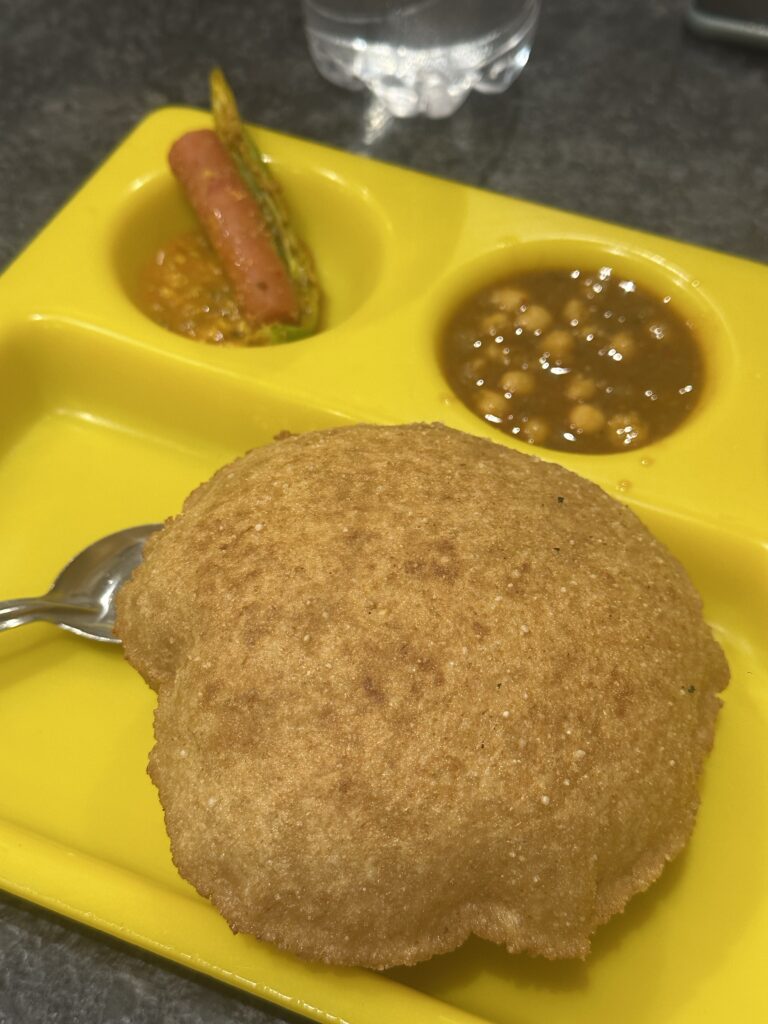
Bedmi puri is a traditional dish combining whole wheat flatbreads with curries and pickled veggies. The bread is deep-fried in oil and puffs up but is hollow inside! We cut pieces of it off to eat and dipped it in the curries (this was served with aloo curry and chickpea curry). It was really good but we were starting to get full.
9. Kachori
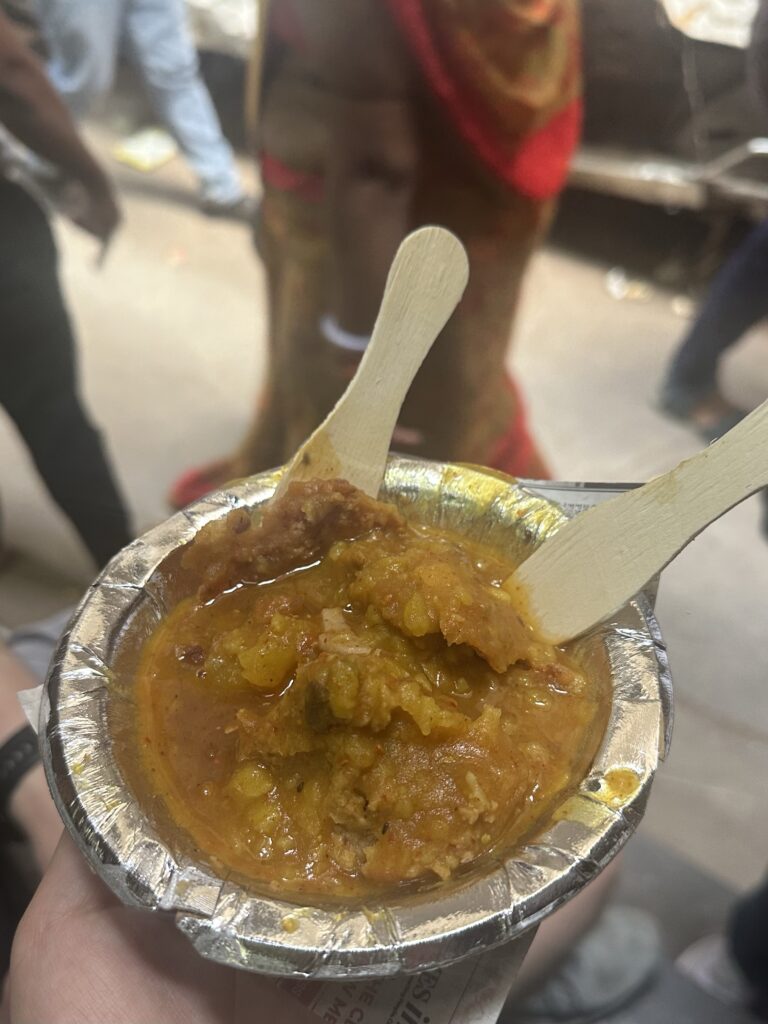
Kachori is made of refined wheat flour, stuffed with lentil paste, deep fried in mustard oil, and served with potato curry and taro root sauce. This was pookie’s favorite dish. It was super spicy and so good but I was fighting to keep eating and didn’t know how much we had left. Not to mention, if we liked something, Sonali would say “fire again?” It was like bottomless chaat up in here and I wanted to have five hundred aloo chaat dishes and veggie samosas but I also wanted to try everything else. We’d ask how much was left to gauge if we could “fire again” and she’d mysteriously be like, “two to twenty more stops” so I just embraced the mystery and kept to one small portion per stop.
10. Parathas
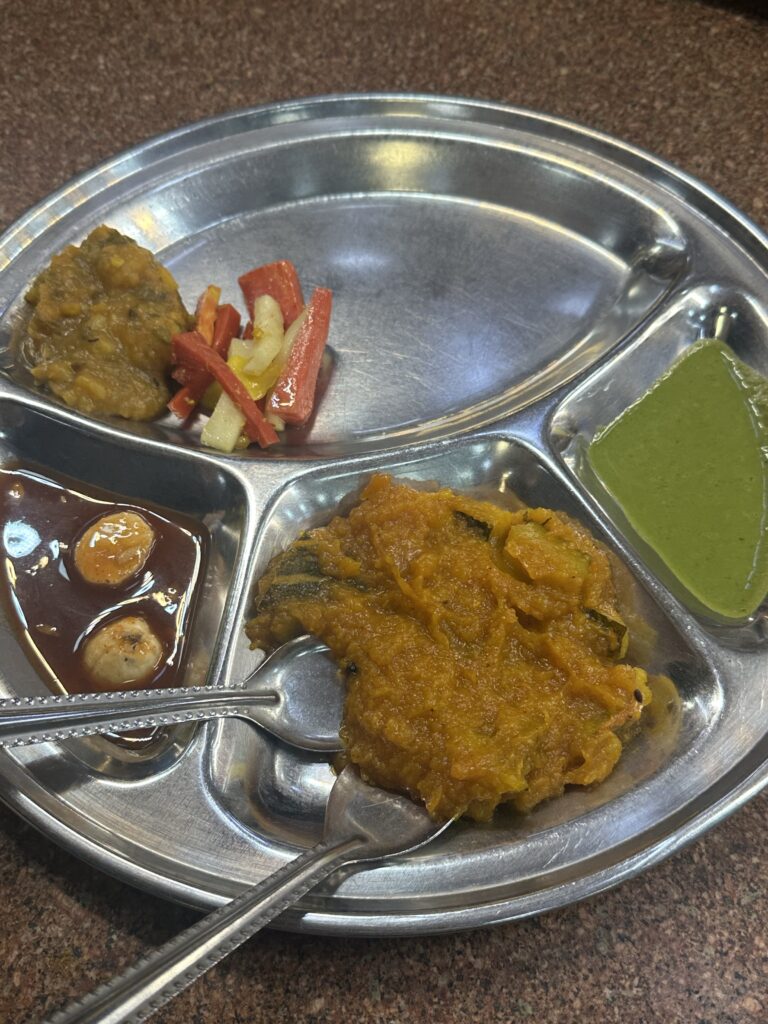
Paratha is flat unleavened bread that gets fried on a griddle. We had onion and potato paratha (not pictured sorry) and we ate it with these chutneys and sauces! Then Sonali gave us rabri, which is a dessert version of it made with bananas and milk. I rallied and ate the entire thing but forgot to take a picture because it was too good to wait. I will dream of it forever.
In conclusion, we had a lot of authentic dishes and no butter chicken so now I feel like a legitimate traveler. And that’s that on the food!
But I’m not done yapping quite yet–a lot happened, okay?
Chandni Chowk, reflective of Delhi as a whole, was sensory overload. Nothing was standalone. There was a myriad of everything: shops, vendors, market stalls, and people; sights, smells, colors, and sounds. We saw an array of spices for sale, carts of fresh fruit on display, intricate saris with detailed lace and beautiful patterns available in every color imaginable. We watched men–either in flip-flops or barefoot–lugging heavy, haphazardly duct-taped supplies around on their shoulders. We saw a man shove an older woman onto the ground for reasons unknown (and unjustifiable! Who pushes over an old lady?) to which she started wailing (I felt so bad for her, but a big group rallied around her and helped her up). We went through a narrow lane overflowing with carts of spices and seasonings that Sonali warned us was nicknamed the “sneeze and cough alley.” I immediately got an ego about it, like I’m not going to sneeze or cough. Flash forward two seconds, and guess who was sneezing and coughing? As I’m hacking up a lung, a man hurried by and knocked into Mitch, spilling piping hot chai down his leg but never breaking stride. A sweet man sitting outside his spice shop immediately handed us a cup of cold water to clean it off and soothe the burn. The yin and yang of human behavior. Pookie was brave about his burning leg, so we continued on.
We passed through alleys with hundreds of loose electrical wires running along their perimeter, at which point Sonali informed us that a majority of them weren’t functional: and that when something stopped working, a new wire was just added to the collection. Things were divided into sections, too. Sonali would say, “this is the wedding section,” and suddenly all of the shops ahead were tailors for saris or stationary stores for wedding invitations. Need something replaced in your home? Look no further than the hardware section, whose stores offered tubes, bolts, wires, and other electrical supplies, all in a row on the same street, practically on top of one another. It was a fascinating system.
As we’re taking all of this in, the following was also occurring: we were learning about Indian food, Indian culture, and Sonali’s life; at the same time, Sonali was trying to learn about our lives; and in the background, every single person we passed was staring at us, some literally gaping. I have never been so overstimulated in my life, and it was a rush. I was honestly loving it: the chaos, the excitement, the constant hustle and bustle. Except for the staring–I was struggling to act impassive about the looks we were getting. Three men passed by on the back of an auto-rickshaw and twisted around to watch us until they faded out of sight. One man stared at me with a scary intensity, unblinking and unapologetic. Sonali turned around and said, “he’s thinking thoughts.” Yeah bestie, I know.
Speaking of Sonali, she gave me frequent “this is your man?” looks throughout the tour when Mitch would do something silly. I pretended to commiserate with her so we could bond but internally I’m thinking “yes, that is my man and I love it.”
And while we’re still on the topic of Sonali, she was an absolute queen. She was so funny and knowledgeable and easy to talk to. It was a great tour by design, but I think she made it that much better with her personality. She hailed us an auto-rickshaw ride back to the hostel and we parted ways. Love you girl.
After we got back to our hostel, we did not leave again except to buy water at a convenience store across the street. We were too full to do anything other than binge House of the Dragon, nap, and debrief. It was an amazing day (smiley face).
Unbeknownst to us, that would be our best day in India, and things were about to head on a downward spiral (frowny face).